Circuit Board Vector Art Simple Circuit Board Vector Art
Section Learning Objectives
By the end of this section, y'all will be able to do the following:
- Explain how a changing magnetic field produces a current in a wire
- Calculate induced electromotive force and current
Instructor Support
Instructor Back up
The learning objectives in this department volition assist your students main the following standards:
- (5) The student knows the nature of forces in the physical earth. The student is expected to:
- (G) investigate and depict the relationship between electric and magnetic fields in applications such as generators, motors, and transformers.
In improver, the OSX High School Physics Laboratory Manual addresses content in this section in the lab titled: Magnetism, as well equally the following standards:
- (5) Science concepts. The student knows the nature of forces in the physical world. The pupil is expected to:
- (G) investigate and describe the human relationship betwixt electric and magnetic fields in applications such as generators, motors, and transformers.
Department Key Terms
| emf | induction | magnetic flux |
Changing Magnetic Fields
In the preceding department, we learned that a current creates a magnetic field. If nature is symmetrical, then perchance a magnetic field can create a current. In 1831, some 12 years after the discovery that an electric current generates a magnetic field, English scientist Michael Faraday (1791–1862) and American scientist Joseph Henry (1797–1878) independently demonstrated that magnetic fields tin produce currents. The bones procedure of generating currents with magnetic fields is called induction; this procedure is also chosen magnetic induction to distinguish it from charging by induction, which uses the electrostatic Coulomb force.
When Faraday discovered what is now called Faraday's police of induction, Queen Victoria asked him what possible use was electricity. "Madam," he replied, "What good is a baby?" Today, currents induced past magnetic fields are essential to our technological guild. The electric generator—institute in everything from automobiles to bicycles to nuclear ability plants—uses magnetism to generate electric current. Other devices that employ magnetism to induce currents include pickup coils in electric guitars, transformers of every size, certain microphones, airport security gates, and damping mechanisms on sensitive chemical balances.
1 experiment Faraday did to demonstrate magnetic induction was to move a bar magnet through a wire coil and measure the resulting electrical electric current through the wire. A schematic of this experiment is shown in Figure xx.33. He found that electric current is induced merely when the magnet moves with respect to the curlicue. When the magnet is motionless with respect to the coil, no current is induced in the gyre, as in Figure 20.33. In improver, moving the magnet in the contrary direction (compare Figure 20.33 with Figure xx.33) or reversing the poles of the magnet (compare Effigy twenty.33 with Figure 20.33) results in a current in the opposite direction.
Figure 20.33 Move of a magnet relative to a ringlet produces electric currents as shown. The same currents are produced if the coil is moved relative to the magnet. The greater the speed, the greater the magnitude of the electric current, and the current is zip when there is no motion. The electric current produced by moving the magnet upward is in the reverse management equally the current produced by moving the magnet downward.
Virtual Physics
Faraday's Law
Try this simulation to run into how moving a magnet creates a current in a excursion. A calorie-free bulb lights upwards to show when electric current is flowing, and a voltmeter shows the voltage drop beyond the light bulb. Endeavour moving the magnet through a iv-turn coil and through a 2-plough coil. For the same magnet speed, which coil produces a college voltage?
With the north pole to the left and moving the magnet from right to left, a positive voltage is produced as the magnet enters the coil. What sign voltage will exist produced if the experiment is repeated with the due south pole to the left?
-
The sign of voltage will change because the management of current flow will change by moving south pole of the magnet to the left.
-
The sign of voltage will remain same considering the management of electric current catamenia will not change by moving south pole of the magnet to the left.
-
The sign of voltage will change because the magnitude of electric current flow volition change by moving south pole of the magnet to the left.
-
The sign of voltage will remain same because the magnitude of electric current flow will not alter by moving south pole of the magnet to the left.
Induced Electromotive Strength
If a current is induced in the whorl, Faraday reasoned that there must be what he called an electromotive force pushing the charges through the coil. This estimation turned out to exist wrong; instead, the external source doing the work of moving the magnet adds free energy to the charges in the roll. The energy added per unit of measurement accuse has units of volts, so the electromotive strength is actually a potential. Unfortunately, the proper name electromotive force stuck and with it the potential for disruptive it with a real forcefulness. For this reason, we avoid the term electromotive force and simply utilize the abbreviation emf, which has the mathematical symbol The emf may be defined every bit the rate at which free energy is drawn from a source per unit current flowing through a circuit. Thus, emf is the energy per unit charge added by a source, which contrasts with voltage, which is the energy per unit charge released as the charges flow through a circuit.
To understand why an emf is generated in a ringlet due to a moving magnet, consider Figure twenty.34, which shows a bar magnet moving downward with respect to a wire loop. Initially, seven magnetic field lines are going through the loop (run across left-manus paradigm). Considering the magnet is moving away from the roll, merely five magnetic field lines are going through the loop afterwards a curt fourth dimension (run into right-mitt prototype). Thus, when a change occurs in the number of magnetic field lines going through the area defined past the wire loop, an emf is induced in the wire loop. Experiments such equally this show that the induced emf is proportional to the rate of change of the magnetic field. Mathematically, we express this as
xx.24
where is the alter in the magnitude in the magnetic field during fourth dimension and A is the expanse of the loop.
Figure 20.34 The bar magnet moves downward with respect to the wire loop, so that the number of magnetic field lines going through the loop decreases with time. This causes an emf to be induced in the loop, creating an electric current.
Notation that magnetic field lines that lie in the plane of the wire loop do not really pass through the loop, as shown by the left-about loop in Figure 20.35. In this figure, the pointer coming out of the loop is a vector whose magnitude is the surface area of the loop and whose direction is perpendicular to the plane of the loop. In Figure 20.35, as the loop is rotated from to the contribution of the magnetic field lines to the emf increases. Thus, what is important in generating an emf in the wire loop is the component of the magnetic field that is perpendicular to the plane of the loop, which is
This is analogous to a sheet in the wind. Recollect of the conducting loop as the canvass and the magnetic field as the wind. To maximize the force of the current of air on the canvass, the sail is oriented so that its surface vector points in the same management as the winds, as in the correct-most loop in Figure twenty.35. When the canvas is aligned so that its surface vector is perpendicular to the air current, as in the left-virtually loop in Figure twenty.35, so the wind exerts no force on the sail.
Thus, taking into business relationship the angle of the magnetic field with respect to the area, the proportionality becomes
twenty.25
Figure 20.35 The magnetic field lies in the plane of the left-nigh loop, so information technology cannot generate an emf in this case. When the loop is rotated then that the angle of the magnetic field with the vector perpendicular to the area of the loop increases to (see right-most loop), the magnetic field contributes maximally to the emf in the loop. The dots testify where the magnetic field lines intersect the plane defined past the loop.
Another fashion to reduce the number of magnetic field lines that go through the conducting loop in Figure 20.35 is not to move the magnet but to make the loop smaller. Experiments show that irresolute the area of a conducting loop in a stable magnetic field induces an emf in the loop. Thus, the emf produced in a conducting loop is proportional to the rate of change of the production of the perpendicular magnetic field and the loop area
20.26
where is the perpendicular magnetic field and A is the area of the loop. The product is very important. It is proportional to the number of magnetic field lines that pass perpendicularly through a surface of surface area A. Going back to our sail analogy, it would be proportional to the forcefulness of the wind on the canvas. It is called the magnetic flux and is represented by .
The unit of magnetic flux is the weber (Wb), which is magnetic field per unit area, or T/1000two. The weber is likewise a volt second (Vs).
The induced emf is in fact proportional to the rate of change of the magnetic flux through a conducting loop.
Finally, for a whorl made from N loops, the emf is Northward times stronger than for a single loop. Thus, the emf induced by a changing magnetic field in a coil of N loops is
The last question to respond earlier nosotros tin can modify the proportionality into an equation is "In what direction does the current menstruum?" The Russian scientist Heinrich Lenz (1804–1865) explained that the electric current flows in the direction that creates a magnetic field that tries to go on the flux constant in the loop. For example, consider over again Effigy twenty.34. The motion of the bar magnet causes the number of up-pointing magnetic field lines that go through the loop to subtract. Therefore, an emf is generated in the loop that drives a current in the direction that creates more upward-pointing magnetic field lines. By using the right-paw rule, we see that this current must flow in the direction shown in the effigy. To express the fact that the induced emf acts to counter the change in the magnetic flux through a wire loop, a minus sign is introduced into the proportionality , which gives Faraday's law of induction.
20.29
Lenz'south law is very of import. To better understand it, consider Figure 20.36, which shows a magnet moving with respect to a wire coil and the direction of the resulting current in the curlicue. In the top row, the northward pole of the magnet approaches the gyre, so the magnetic field lines from the magnet point toward the roll. Thus, the magnetic field pointing to the correct increases in the coil. Co-ordinate to Lenz's law, the emf produced in the ringlet will bulldoze a current in the direction that creates a magnetic field inside the coil pointing to the left. This will counter the increase in magnetic flux pointing to the correct. To see which way the current must flow, point your right thumb in the desired direction of the magnetic field and the electric current will period in the management indicated by curling your right fingers. This is shown by the paradigm of the right hand in the peak row of Effigy 20.36. Thus, the electric current must menstruation in the management shown in Effigy iv(a).
In Figure 4(b), the direction in which the magnet moves is reversed. In the coil, the right-pointing magnetic field due to the moving magnet decreases. Lenz'south police force says that, to counter this subtract, the emf will drive a current that creates an boosted correct-pointing magnetic field in the ringlet. Again, betoken your right pollex in the desired direction of the magnetic field, and the current will menses in the direction betoken by crimper your right fingers (Figure 4(b)).
Finally, in Figure 4(c), the magnet is reversed and then that the due south pole is nearest the gyre. Now the magnetic field points toward the magnet instead of toward the coil. As the magnet approaches the gyre, it causes the left-pointing magnetic field in the coil to increase. Lenz's law tells us that the emf induced in the curlicue will drive a current in the management that creates a magnetic field pointing to the right. This will counter the increasing magnetic flux pointing to the left due to the magnet. Using the right-hand rule again, as indicated in the figure, shows that the current must menstruum in the direction shown in Effigy four(c).
Figure 20.36 Lenz's law tells usa that the magnetically induced emf will drive a current that resists the change in the magnetic flux through a excursion. This is shown in panels (a)–(c) for various magnet orientations and velocities. The right hands at right evidence how to apply the right-hand dominion to find in which direction the induced electric current flows effectually the coil.
Virtual Physics
Faraday'due south Electromagnetic Lab
This simulation proposes several activities. For now, click on the tab Pickup Coil, which presents a bar magnet that yous can motility through a scroll. As you do so, y'all can see the electrons move in the coil and a lite bulb will light upwardly or a voltmeter will indicate the voltage across a resistor. Notation that the voltmeter allows you to encounter the sign of the voltage as you move the magnet about. You tin likewise leave the bar magnet at rest and move the coil, although it is more than difficult to observe the results.
PhET Explorations: Faraday's Electromagnetic Lab Play with a bar magnet and coils to learn about Faraday's police. Move a bar magnet nearly 1 or ii coils to brand a lite bulb glow. View the magnetic field lines. A meter shows the direction and magnitude of the electric current. View the magnetic field lines or use a meter to show the direction and magnitude of the current. You lot can as well play with electromagnets, generators and transformers!
Orient the bar magnet with the north pole facing to the right and place the pickup coil to the right of the bar magnet. Now movement the bar magnet toward the coil and observe in which mode the electrons movement. This is the same situation as depicted below. Does the current in the simulation menses in the same direction as shown below? Explicate why or why not. 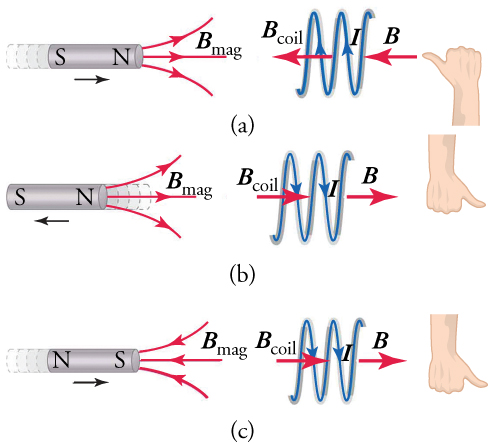
-
Yes, the electric current in the simulation flows as shown considering the management of current is reverse to the direction of period of electrons.
-
No, current in the simulation flows in the opposite direction because the direction of current is same to the management of flow of electrons.
Watch Physics
Induced Current in a Wire
This video explains how a current can be induced in a straight wire by moving it through a magnetic field. The lecturer uses the cross product, which a blazon of vector multiplication. Don't worry if you are not familiar with this, it basically combines the right-hand rule for determining the force on the charges in the wire with the equation
Grasp Check
What emf is produced across a straight wire 0.50 k long moving at a velocity of (1.v thou/s) through a uniform magnetic field (0.30 T)ẑ? The wire lies in the ŷ-direction. Also, which finish of the wire is at the higher potential—let the lower cease of the wire exist at y = 0 and the upper stop at y = 0.5 g)?
- 0.15 V and the lower end of the wire will be at higher potential
- 0.15 5 and the upper terminate of the wire will exist at college potential
- 0.075 V and the lower end of the wire volition be at college potential
- 0.075 5 and the upper end of the wire will be at higher potential
Worked Example
EMF Induced in Conducing Ringlet by Moving Magnet
Imagine a magnetic field goes through a coil in the direction indicated in Effigy 20.37. The coil diameter is 2.0 cm. If the magnetic field goes from 0.020 to 0.010 T in 34 s, what is the direction and magnitude of the induced current? Presume the coil has a resistance of 0.one
Figure 20.37 A coil through which passes a magnetic field B.
Strategy
Employ the equation to notice the induced emf in the coil, where . Counting the number of loops in the solenoid, we find it has 16 loops, then Apply the equation to summate the magnetic flux
20.xxx
where d is the bore of the solenoid and nosotros take used Because the surface area of the solenoid does non vary, the change in the magnetic of the flux through the solenoid is
xx.31
Once we notice the emf, we can use Ohm'south police force, to find the current.
Finally, Lenz'south law tells the states that the current should produce a magnetic field that acts to oppose the decrease in the applied magnetic field. Thus, the electric current should produce a magnetic field to the correct.
Discussion
Let's see if the minus sign makes sense in Faraday's constabulary of induction. Define the management of the magnetic field to be the positive management. This means the change in the magnetic field is negative, every bit we found above. The minus sign in Faraday'south law of consecration negates the negative change in the magnetic field, leaving us with a positive current. Therefore, the electric current must flow in the direction of the magnetic field, which is what we plant.
Now endeavour defining the positive management to be the direction contrary that of the magnetic field, that is positive is to the left in Effigy 20.37. In this case, yous will find a negative current. But since the positive direction is to the left, a negative electric current must menstruation to the right, which again agrees with what we institute by using Lenz's police force.
Worked Example
Magnetic Consecration due to Changing Circuit Size
The excursion shown in Figure 20.38 consists of a U-shaped wire with a resistor and with the ends connected by a sliding conducting rod. The magnetic field filling the area enclosed by the circuit is constant at 0.01 T. If the rod is pulled to the right at speed what current is induced in the circuit and in what management does the current flow?
Figure 20.38 A slider circuit. The magnetic field is constant and the rod is pulled to the right at speed 5. The changing area enclosed by the excursion induces an emf in the circuit.
Strategy
We again use Faraday'due south law of induction, although this time the magnetic field is constant and the expanse enclosed by the excursion changes. The excursion contains a single loop, and then The rate of change of the surface area is Thus the rate of change of the magnetic flux is
20.34
where we have used the fact that the angle between the area vector and the magnetic field is 0°. Once we know the emf, we can find the current by using Ohm'southward law. To find the management of the current, we apply Lenz's law.
Discussion
Is energy conserved in this circuit? An external agent must pull on the rod with sufficient forcefulness to merely balance the force on a current-carrying wire in a magnetic field—recall that The charge per unit at which this force does piece of work on the rod should be balanced by the charge per unit at which the circuit dissipates ability. Using the force required to pull the wire at a constant speed v is
20.37
where we used the fact that the bending betwixt the current and the magnetic field is Inserting our expression higher up for the current into this equation gives
twenty.38
The power contributed by the agent pulling the rod is
twenty.39
The power dissipated by the circuit is
20.forty
We thus see that which ways that ability is conserved in the system consisting of the excursion and the agent that pulls the rod. Thus, free energy is conserved in this system.
Practice Problems
11 .
The magnetic flux through a single wire loop changes from 3.v Wb to 1.five Wb in 2.0 south. What emf is induced in the loop?
- –2.0 V
- –i.0 V
- +1.0 Five
- +ii.0 Five
12 .
What is the emf for a ten-plough coil through which the flux changes at 10 Wb/s?
- –100 V
- –10 V
- +10 5
- +100 V
Check Your Understanding
13 .
Given a bar magnet, how can you induce an electric current in a wire loop?
-
An electric current is induced if a bar magnet is placed near the wire loop.
-
An electric current is induced if a wire loop is wound around the bar magnet.
-
An electric current is induced if a bar magnet is moved through the wire loop.
-
An electric current is induced if a bar magnet is placed in contact with the wire loop.
xiv .
What factors can cause an induced current in a wire loop through which a magnetic field passes?
-
Induced electric current tin can be created by changing the size of the wire loop only.
-
Induced current tin be created by changing the orientation of the wire loop merely.
-
Induced current can be created by changing the strength of the magnetic field only.
-
Induced current can be created past changing the strength of the magnetic field, changing the size of the wire loop, or irresolute the orientation of the wire loop.
Source: https://openstax.org/books/physics/pages/20-3-electromagnetic-induction
0 Response to "Circuit Board Vector Art Simple Circuit Board Vector Art"
Post a Comment