What Is the Term Used to Describe the Changes in Allele Frequencies of a Population Over Generations
Learning Objectives
By the end of this department, you will be able to:
- Define population genetics and draw how population genetics is used in the study of the evolution of populations
- Define the Hardy-Weinberg principle and discuss its importance
The mechanisms of inheritance, or genetics, were non understood at the fourth dimension Charles Darwin and Alfred Russel Wallace were developing their thought of natural selection. This lack of understanding was a stumbling block to agreement many aspects of evolution. In fact, the predominant (and incorrect) genetic theory of the time, blending inheritance, fabricated information technology difficult to understand how natural selection might operate. Darwin and Wallace were unaware of the genetics work by Austrian monk Gregor Mendel, which was published in 1866, not long after publication of Darwin'south volume, On the Origin of Species. Mendel's work was rediscovered in the early twentieth century at which time geneticists were rapidly coming to an understanding of the basics of inheritance. Initially, the newly discovered particulate nature of genes made it hard for biologists to understand how gradual development could occur. Merely over the next few decades genetics and evolution were integrated in what became known every bit the modern synthesis—the coherent understanding of the human relationship between natural pick and genetics that took shape by the 1940s and is generally accustomed today. In sum, the modern synthesis describes how evolutionary processes, such as natural selection, tin bear upon a population's genetic makeup, and, in turn, how this tin result in the gradual evolution of populations and species. The theory besides connects this modify of a population over time, chosen microevolution, with the processes that gave rise to new species and higher taxonomic groups with widely divergent characters, called macroevolution.
Everyday Connection
Evolution and Influenza VaccinesEvery autumn, the media starts reporting on flu vaccinations and potential outbreaks. Scientists, health experts, and institutions determine recommendations for different parts of the population, predict optimal product and inoculation schedules, create vaccines, and set upwards clinics to provide inoculations. You may think of the annual flu shot as a lot of media hype, an of import health protection, or but a briefly uncomfortable prick in your arm. Just practice you lot recall of information technology in terms of evolution?
The media hype of almanac flu shots is scientifically grounded in our understanding of evolution. Each year, scientists across the globe strive to predict the influenza strains that they anticipate beingness most widespread and harmful in the coming year. This knowledge is based in how flu strains have evolved over fourth dimension and over the past few flu seasons. Scientists then work to create the nigh constructive vaccine to combat those selected strains. Hundreds of millions of doses are produced in a short period in order to provide vaccinations to primal populations at the optimal time.
Because viruses, like the flu, evolve very apace (especially in evolutionary time), this poses quite a claiming. Viruses mutate and replicate at a fast charge per unit, so the vaccine developed to protect confronting terminal yr's flu strain may not provide the protection needed against the coming year's strain. Evolution of these viruses means continued adaptions to ensure survival, including adaptations to survive previous vaccines.
Population Genetics
Recall that a gene for a particular character may accept several alleles, or variants, that lawmaking for unlike traits associated with that character. For case, in the ABO blood type system in humans, three alleles determine the particular blood-blazon protein on the surface of reddish claret cells. Each individual in a population of diploid organisms can simply acquit 2 alleles for a particular gene, but more than two may be nowadays in the individuals that make up the population. Mendel followed alleles as they were inherited from parent to offspring. In the early twentieth century, biologists in a subject known equally population genetics began to written report how selective forces change a population through changes in allele and genotypic frequencies.
The allele frequency (or gene frequency) is the charge per unit at which a specific allele appears inside a population. Until now we have discussed evolution every bit a change in the characteristics of a population of organisms, but behind that phenotypic change is genetic modify. In population genetics, the term evolution is defined every bit a change in the frequency of an allele in a population. Using the ABO blood type system as an example, the frequency of one of the alleles, I A, is the number of copies of that allele divided past all the copies of the ABO cistron in the population. For instance, a study in Jordan ane found a frequency of I A to be 26.one percentage. The I B and I 0 alleles made up 13.four percent and threescore.5 percent of the alleles respectively, and all of the frequencies added up to 100 percent. A change in this frequency over fourth dimension would constitute evolution in the population.
The allele frequency within a given population tin can change depending on environmental factors; therefore, certain alleles become more widespread than others during the process of natural selection. Natural selection can change the population'south genetic makeup; for case, if a given allele confers a phenotype that allows an individual to better survive or accept more offspring. Considering many of those offspring will also carry the beneficial allele, and often the respective phenotype, they will have more offspring of their own that likewise carry the allele, thus, perpetuating the cycle. Over time, the allele will spread throughout the population. Some alleles volition rapidly become fixed in this way, meaning that every individual of the population will carry the allele, while detrimental mutations may be swiftly eliminated if derived from a dominant allele from the gene puddle. The factor puddle is the sum of all the alleles in a population.
Sometimes, allele frequencies within a population alter randomly with no advantage to the population over existing allele frequencies. This miracle is called genetic migrate. Natural selection and genetic drift usually occur simultaneously in populations and are not isolated events. It is hard to determine which process dominates considering it is often most impossible to determine the cause of alter in allele frequencies at each occurrence. An upshot that initiates an allele frequency change in an isolated part of the population, which is not typical of the original population, is called the founder consequence. Natural option, random drift, and founder furnishings tin can atomic number 82 to significant changes in the genome of a population.
Hardy-Weinberg Principle of Equilibrium
In the early twentiethcentury, English mathematician Godfrey Hardy and High german doc Wilhelm Weinberg stated the principle of equilibrium to describe the genetic makeup of a population. The theory, which afterwards became known every bit the Hardy-Weinberg principle of equilibrium, states that a population'due south allele and genotype frequencies are inherently stable— unless some kind of evolutionary force is acting upon the population, neither the allele nor the genotypic frequencies would change. The Hardy-Weinberg principle assumes conditions with no mutations, migration, emigration, or selective pressure for or against genotype, plus an space population; while no population can satisfy those conditions, the principle offers a useful model against which to compare real population changes.
Working under this theory, population geneticists represent unlike alleles every bit unlike variables in their mathematical models. The variable p, for example, often represents the frequency of a particular allele, say Y for the trait of yellow in Mendel'south peas, while the variable q represents the frequency of y alleles that confer the colour green. If these are the simply ii possible alleles for a given locus in the population, p + q = one. In other words, all the p alleles and all the q alleles make upward all of the alleles for that locus that are institute in the population.
Merely what ultimately interests about biologists is non the frequencies of different alleles, but the frequencies of the resulting genotypes, known equally the population's genetic structure, from which scientists can surmise the distribution of phenotypes. If the phenotype is observed, only the genotype of the homozygous recessive alleles tin be known; the calculations provide an gauge of the remaining genotypes. Since each individual carries two alleles per factor, if the allele frequencies (p and q) are known, predicting the frequencies of these genotypes is a simple mathematical calculation to determine the probability of getting these genotypes if two alleles are drawn at random from the gene puddle. And so in the to a higher place scenario, an individual pea institute could be pp (YY), and thus produce yellow peas; pq (Yy), also xanthous; or qq (yy), and thus producing dark-green peas ([Figure ane]). In other words, the frequency of pp individuals is simply p2; the frequency of pq individuals is 2pq; and the frequency of qq individuals is q2. And, once again, if p and q are the just two possible alleles for a given trait in the population, these genotypes frequencies will sum to i: pii + 2pq + q2 = 1.
Art Connectedness
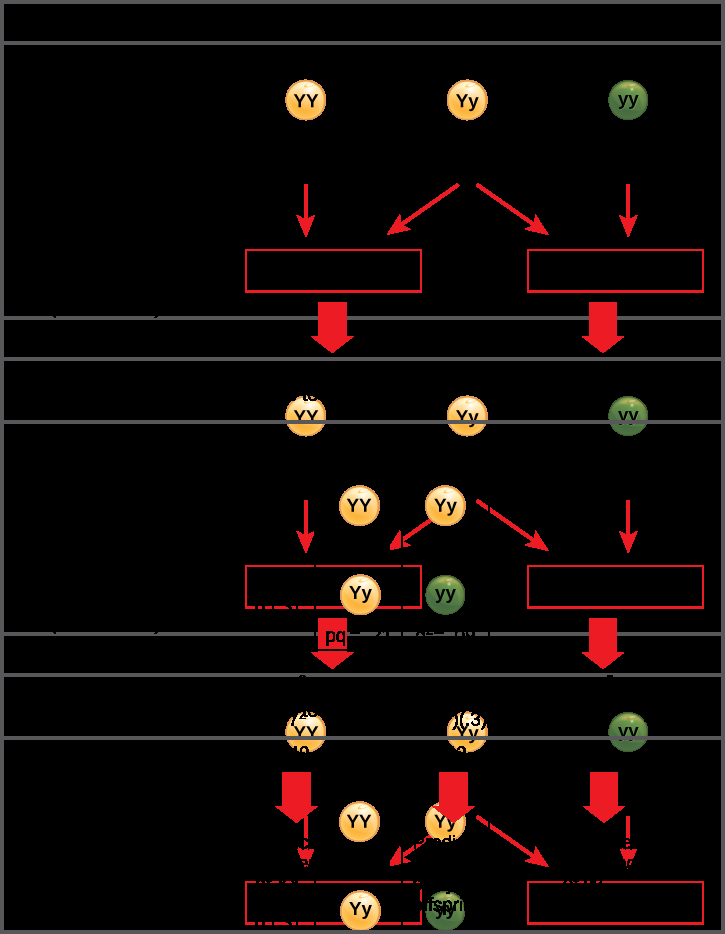
Figure one: When populations are in the Hardy-Weinberg equilibrium, the allelic frequency is stable from generation to generation and the distribution of alleles can be determined from the Hardy-Weinberg equation. If the allelic frequency measured in the field differs from the predicted value, scientists can make inferences about what evolutionary forces are at play.
In plants, violet flower colour (V) is dominant over white (5). If p = 0.eight and q = 0.2 in a population of 500 plants, how many individuals would y'all expect to be homozygous dominant (VV), heterozygous (Vv), and homozygous recessive (vv)? How many plants would y'all expect to have violet flowers, and how many would accept white flowers?
Show Answer
The expected distribution is 320 VV, 160Vv, and 20 vv plants. Plants with VV or Vv genotypes would accept violet flowers, and plants with the vv genotype would have white flowers, so a full of 480 plants would be expected to have violet flowers, and xx plants would take white flowers.
In theory, if a population is at equilibrium—that is, in that location are no evolutionary forces acting upon it—generation after generation would have the same cistron pool and genetic structure, and these equations would all hold true all of the fourth dimension. Of class, fifty-fifty Hardy and Weinberg recognized that no natural population is immune to evolution. Populations in nature are constantly irresolute in genetic makeup due to drift, mutation, mayhap migration, and selection. As a result, the only way to determine the exact distribution of phenotypes in a population is to go out and count them. Just the Hardy-Weinberg principle gives scientists a mathematical baseline of a not-evolving population to which they can compare evolving populations and thereby infer what evolutionary forces might be at play. If the frequencies of alleles or genotypes deviate from the value expected from the Hardy-Weinberg equation, then the population is evolving.
Section Summary
The modern synthesis of evolutionary theory grew out of the cohesion of Darwin'due south, Wallace's, and Mendel'south thoughts on evolution and heredity, forth with the more than modern study of population genetics. Information technology describes the development of populations and species, from small-calibration changes among individuals to large-scale changes over paleontological time periods. To understand how organisms evolve, scientists can track populations' allele frequencies over time. If they differ from generation to generation, scientists can conclude that the population is not in Hardy-Weinberg equilibrium, and is thus evolving.
Review Questions
What is the departure betwixt micro- and macroevolution?
- Microevolution describes the evolution of small organisms, such as insects, while macroevolution describes the evolution of large organisms, like people and elephants.
- Microevolution describes the evolution of microscopic entities, such as molecules and proteins, while macroevolution describes the evolution of whole organisms.
- Microevolution describes the evolution of organisms in populations, while macroevolution describes the development of species over long periods of fourth dimension.
- Microevolution describes the evolution of organisms over their lifetimes, while macroevolution describes the evolution of organisms over multiple generations.
Population genetics is the study of:
- how selective forces change the allele frequencies in a population over time
- the genetic footing of population-broad traits
- whether traits have a genetic ground
- the degree of inbreeding in a population
Which of the following populations is not in Hardy-Weinberg equilibrium?
- a population with 12 homozygous recessive individuals (yy), 8 homozygous ascendant individuals (YY), and four heterozygous individuals (Yy)
- a population in which the allele frequencies practice not change over fourth dimension
- p2 + 2pq + q2 = 1
- a population undergoing natural selection
One of the original Amish colonies rose from a ship of colonists that came from Europe. The transport'south helm, who had polydactyly, a rare ascendant trait, was one of the original colonists. Today, we meet a much college frequency of polydactyly in the Amish population. This is an case of:
- natural selection
- genetic drift
- founder effect
- b and c
Gratuitous Response
Solve for the genetic structure of a population with 12 homozygous recessive individuals (yy), eight homozygous dominant individuals (YY), and 4 heterozygous individuals (Yy).
p = (eight*2 + 4)/48 = .42; q = (12*2 + iv)/48 = .58; pii = .17; 2pq = .48; q2 = .34
Explain the Hardy-Weinberg principle of equilibrium theory.
The Hardy-Weinberg principle of equilibrium is used to describe the genetic makeup of a population. The theory states that a population's allele and genotype frequencies are inherently stable: unless some kind of evolutionary forcefulness is acting upon the population, generation after generation of the population would deport the same genes, and individuals would, as a whole, look essentially the aforementioned.
Imagine y'all are trying to test whether a population of flowers is undergoing evolution. You lot suspect there is selection pressure on the color of the bloom: bees seem to cluster around the red flowers more oft than the blueish flowers. In a separate experiment, you observe blue flower color is dominant to red flower colour. In a field, you count 600 blue flowers and 200 cherry flowers. What would yous expect the genetic structure of the flowers to exist?
Ruby-red is recessive and so q2 = 200/800 = 0.25; q = 0.5; p = 1-q = 0.5; p2 = 0.25; 2pq = 0.five. You lot would look 200 homozygous blueish flowers, 400 heterozygous blue flowers, and 200 red flowers.
Footnotes
- 1 Sahar S. Hanania, Dhia S. Hassawi, and Nidal M. Irshaid, "Allele Frequency and Molecular Genotypes of ABO Blood Group System in a Jordanian Population," Periodical of Medical Sciences 7 (2007): 51-58, doi:ten.3923/jms.2007.51.58.
Glossary
- allele frequency
- (also, gene frequency) rate at which a specific allele appears within a population
- founder effect
- outcome that initiates an allele frequency change in part of the population, which is non typical of the original population
- genetic pool
- all of the alleles carried by all of the individuals in the population
- genetic structure
- distribution of the different possible genotypes in a population
- macroevolution
- broader scale evolutionary changes seen over paleontological time
- microevolution
- changes in a population's genetic construction
- modern synthesis
- overarching evolutionary image that took shape past the 1940s and is by and large accepted today
- population genetics
- study of how selective forces change the allele frequencies in a population over time
Source: https://courses.lumenlearning.com/os-biology/chapter/population-evolution/
0 Response to "What Is the Term Used to Describe the Changes in Allele Frequencies of a Population Over Generations"
Post a Comment